Railway bridges carry heavier and more concentrated loads than road bridges of a similar span, and they are far less tolerant of deflection. A road bridge can accept movement that a railway bridge cannot, because track geometry has to stay within tight limits for the line to remain in service. That single difference drives much of how these structures get analysed.
What governs the design
Four things tend to control the outcome on rail projects:
Dynamic effects. Rail loading is not static. Axle loads arrive in sequence at speed, so the analysis has to account for dynamic amplification rather than treating the train as a standing load. On shorter spans this often governs.
Deflection and track geometry. Limits on vertical deflection, end rotation and twist exist to protect the track, not the structure. A bridge can be strong enough and still fail these checks.
Track and structure interaction. Continuously welded rail and the bridge deck are not independent. Longitudinal forces transfer between them under braking, acceleration and temperature change, and the analysis has to treat them as one system.
Working over a live railway. Possession windows are short and infrequent. Design decisions that reduce time on track, such as prefabrication or staged installation, are often worth more to the client than material savings.
Structure types in this work
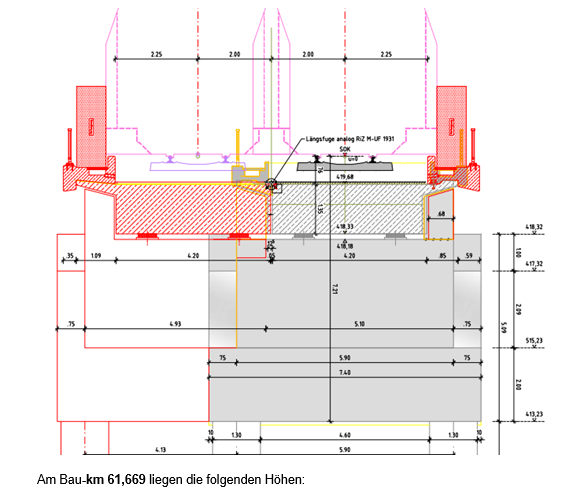
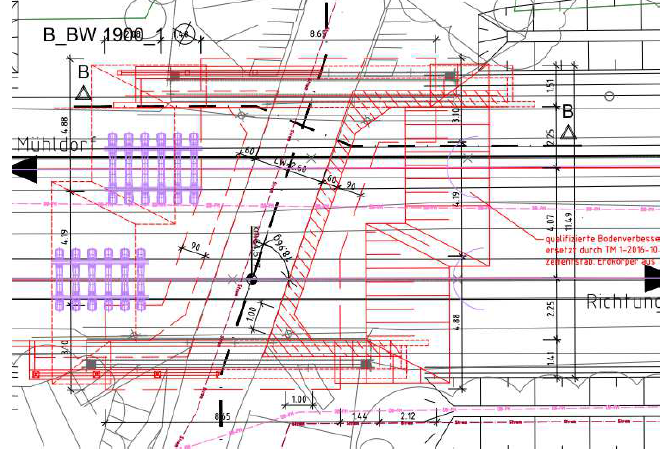
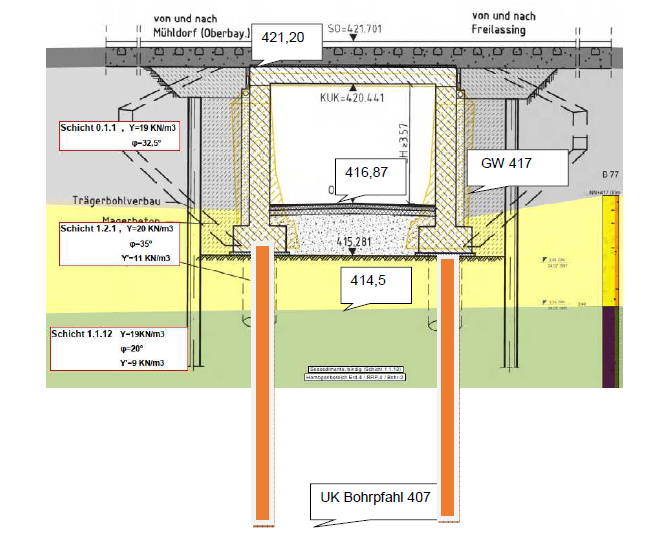
Our railway projects for DB German Rail and its network arm have covered prestressed concrete bridges, composite steel and concrete decks, reinforced concrete frame structures including skew frames, retaining walls supporting rail infrastructure, and steel pedestrian bridges over active tracks.
A large share is refurbishment rather than new build. Germany has a substantial stock of mid-century rail bridges that are structurally sound but no longer meet current load models or clearance requirements. Assessing what an existing structure can carry, then designing the strengthening that closes the gap, is a different problem from designing new, and often a harder one. The geometry is fixed, the material properties have to be established rather than specified, and the work has to happen around a railway that keeps running.
Standards and tools
Analysis and design are carried out to the Eurocodes as adopted in Germany, DIN EN 1990 through 1998, alongside the DB guideline drawings that apply to specific details. Cap widening and parapet adaptation, for example, follow the relevant Riz sheets rather than being designed from first principles.
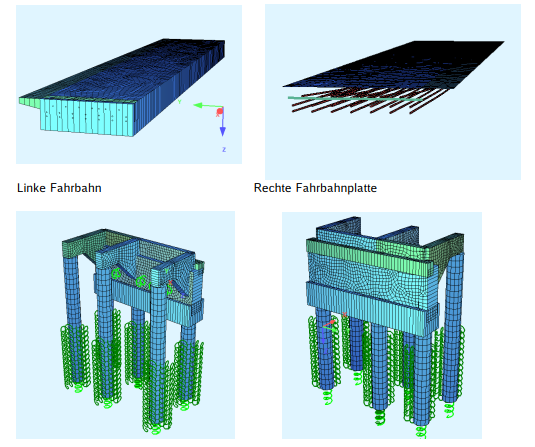
Finite element modelling is done in SOFiSTiK, Dlubal and RFEM, with GGU for geotechnical work. Detailing and drawings are produced in Nemetschek and AutoCAD.