
Railway bridges
Refurbishing a prestressed concrete rail bridge: analysis, new cross-section and reinforcement
Statical analysis and refurbishment of prestressed concrete railway bridges for DB German Rail, covering assessment of the existing structure, cross-section upgrade and added reinforcement.
Refurbishment starts from a harder position than new design. On a new structure you choose the geometry and specify the materials. On an existing bridge both are already fixed, and the first job is finding out what you actually have.
We carried out comprehensive statical analysis for prestressed concrete railway bridges in the DB German Rail network, including refurbishment with new cross-sections and added reinforcement.
Why these bridges need assessing
Germany’s rail network carries a large stock of prestressed concrete bridges built from the 1950s onward. Most are in sound condition. The reason they come up for assessment is usually not deterioration but change: load models have been revised, traffic has grown heavier, clearance requirements have tightened, or the line is being upgraded and the structure has to accommodate something it was never designed for.
An assessment answers a narrow question. Not “is this bridge adequate” in general, but “does this bridge satisfy current requirements for the loading it will now carry”. A structure can pass comfortably under the code it was designed to and still fail against a current load model.
Establishing the existing capacity
The analysis has to be built on what the structure is, not what the drawings say it should be. For prestressed concrete that means resolving several unknowns.
Prestress losses. Creep, shrinkage and relaxation reduce the effective prestress over decades. The remaining force is what governs behaviour under service loads, and it has to be estimated from the age and history of the structure rather than assumed at the design value.
Tendon condition and position. Duct grouting quality and tendon layout affect both durability and capacity. Where records are incomplete, this needs investigation rather than assumption.
Concrete and reinforcement properties. Actual material strengths often exceed the specified values, which can work in the assessment’s favour, but only if they are established by testing rather than assumed.
Getting these right matters more than refining the analysis model. A precise calculation built on an assumed prestress value is a precise calculation of the wrong structure.
FEM modelling
Detailed finite element simulation was used to assess structural integrity and performance under a range of load conditions. For a prestressed deck the model needs to represent the prestress as an applied action rather than a material property, capture the construction sequence where it affects the locked-in stress state, and cover the load cases that govern at different points along the span.
Rail loading adds requirements that road bridge analysis does not have. Dynamic amplification has to be applied to the static load model, and deflection and end rotation have to be checked against track geometry limits, not just structural ones. On refurbishment these serviceability checks frequently govern, because the existing structure was designed against limits that have since been tightened.
Cross-section upgrade and reinforcement
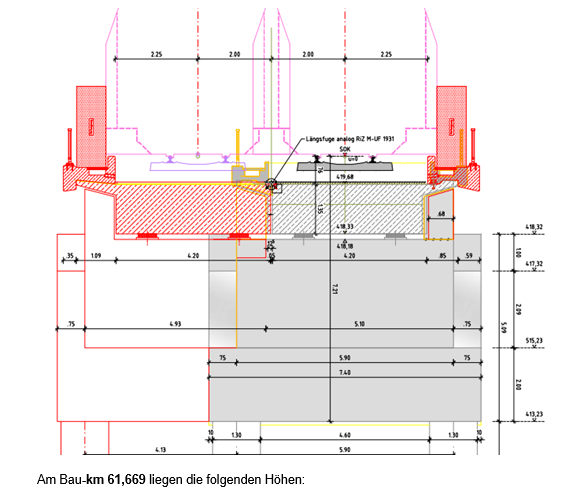
The refurbishment included upgrading the bridge’s cross-section and adding new reinforcement to improve durability and safety.
Widening a deck changes more than the deck. Additional width adds permanent load across the whole span, shifts the load path into the existing bearings and substructure, and alters how the structure distributes load transversely. The supporting elements have to be checked against the revised loading even where no work is planned on them, and it is common for the substructure rather than the deck to become the limiting element.
Added reinforcement has to be made to work with a structure that is already carrying load. New reinforcement only takes up force from additional load applied after it is installed, so it does not relieve the existing stress state. Where strengthening is needed against permanent load, the structure has to be unloaded first, or the analysis has to account for the fact that the new material starts from an unstressed position.
Working around an operating railway
None of this happens on a closed site. Access is limited to possession windows, often at night and measured in hours. That constraint shapes the engineering rather than just the programme. Details that can be installed quickly, in sequence, and checked immediately are worth more than details that are marginally more efficient but need extended access.
Standards and tools
Analysis and design were carried out to the Eurocodes as adopted in Germany, DIN EN 1990 through 1998, with DB guideline drawings governing standard details such as cap widening and parapet adaptation. Finite element modelling used SOFiSTiK, Dlubal and RFEM. Drawings were produced in Nemetschek and AutoCAD.
The output is a static analysis document suitable for submission and approval, containing the analysis, cross-sectional drawings, plan overviews and the FEM model results.
Discuss a similar project
If you have a structure that needs analysis, design, or static analysis documentation for approval, we are happy to look at it.