
Railway bridges
Concrete frame rail bridge on a special anchor foundation
Design and analysis of a reinforced concrete frame rail bridge founded on bored piles with a special anchor arrangement, where ground conditions and groundwater governed the foundation concept.
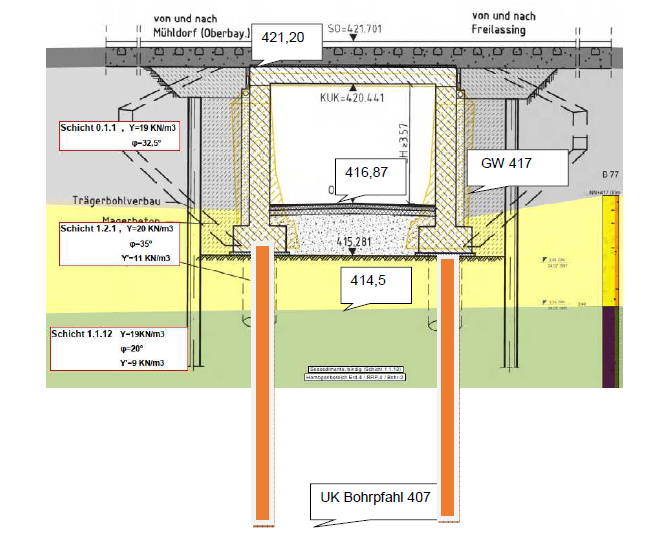
When a frame structure sits in weak ground with high groundwater, the foundation stops being a detail that follows the superstructure design and becomes the thing that determines it.
This project covered design and analysis of a concrete frame structure with a special anchor foundation for a railway bridge in the DB German Rail network.
Reading the ground first
The section through this structure records what the analysis had to work with: distinct soil layers each with their own unit weight and friction angle, a groundwater level sitting above founding level, and a bored pile solution taken down past the weaker material.
Those numbers set the problem. Layers with low friction angles will not carry the frame on spread footings at a sensible depth, so load has to be taken to competent material below. Groundwater above founding level introduces uplift on the structure and requires the excavation to be supported and dewatered rather than simply cut.
Why an anchor arrangement is needed
A buried frame in high groundwater has a problem that surface structures do not. The structure displaces water, and the water pushes back. When the buoyant force exceeds the weight of the structure and the material above it, the frame wants to float.
There are three ways to deal with it. Add enough weight to hold the structure down, which is expensive and adds load to ground that was weak to begin with. Rely on friction from surrounding material, which is unreliable and cannot be counted on in saturated ground. Or anchor the structure into competent material below, which is what a special anchor foundation does.
Anchored piles work in tension rather than compression, which reverses the usual design assumption. The pile has to develop uplift resistance through shaft friction along its embedded length, the connection between pile and base slab has to transfer tension rather than bearing, and the reinforcement has to be continuous through a joint that would otherwise just be a construction detail.
The governing case is often not the finished structure in service. It is the structure complete but not yet backfilled, when the weight holding it down is at its lowest and the water table has recovered after dewatering stops. That temporary condition has to be checked explicitly, and it frequently controls the anchor design.
Frame and foundation as one system
A frame founded on piles cannot be analysed as a frame sitting on fixed supports. Pile stiffness affects how moment distributes through the frame, and differential settlement between piles introduces forces that a rigid-support model never produces.
The practical approach is to model the piles as springs with stiffness derived from the geotechnical assessment, then check the frame against a range of stiffness values rather than a single figure. Ground stiffness is never known precisely, and a design that only works for one assumed value is not a design.
Earth pressure on the frame walls is part of the same system. Active and at-rest pressure give different answers, and which applies depends on whether the wall can move enough to mobilise active conditions. For a stiff closed frame it usually cannot, so at-rest pressure governs and the walls carry more than a retaining wall of the same height would.
Standards and tools
Design followed the Eurocodes as adopted in Germany, DIN EN 1990 through 1998, with DIN EN 1997 governing the geotechnical design of the piles and the verification against uplift. Structural analysis used SOFiSTiK, Dlubal and RFEM. Geotechnical checks, including pile capacity and earth pressure, were carried out in GGU.
The static analysis document covers the frame model, the pile design in both compression and tension, the uplift verification for the temporary and permanent cases, and the reinforcement drawings for the pile-to-slab connection.
Discuss a similar project
If you have a structure that needs analysis, design, or static analysis documentation for approval, we are happy to look at it.